%20-%20Copie.png)
Essential Tools for Learning Biblical Hebrew: A Scholarly Resource Guide
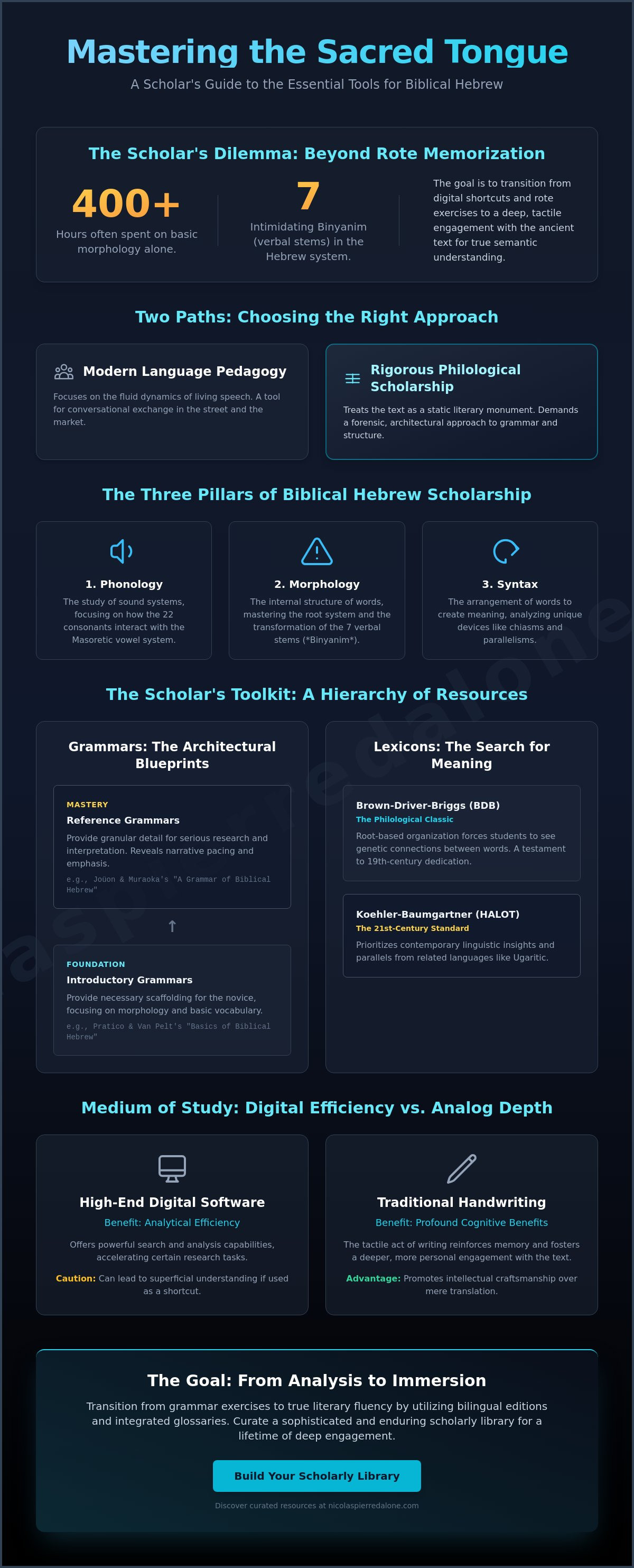
What if the digital convenience of a modern application is actually the greatest barrier to your philological fluency? Serious students often spend over 400 hours mastering basic morphology only to remain intimidated by the 7 binyanim of the Hebrew verbal system. It's a common frustration to find yourself trapped in a cycle of rote memorisation without reaching a true semantic understanding of the text. Selecting the right tools for learning biblical hebrew requires a departure from superficial methods in favor of academic rigor and curated precision.
You'll discover a selection of analytical lexicons, rigorous grammars, and immersive bilingual editions designed to elevate your mastery of the Sacred Tongue. This guide establishes a clear hierarchy of study materials. It provides a sustainable methodology for long-term scholarship that respects the heritage of the text. We'll explore how to transition from digital shortcuts to a deep, tactile engagement with the ancient word. This curated approach ensures your study is an act of intellectual craftsmanship rather than a mere exercise in translation.
Key Takeaways
Distinguish between modern language pedagogy and rigorous philological scholarship to establish a firm foundation in phonology and syntax.
Evaluate the hierarchy of authoritative grammars and the enduring relevance of the Brown-Driver-Briggs lexicon for precise textual analysis.
Compare the analytical efficiency of high-end digital software with the profound cognitive benefits of traditional Hebrew handwriting.
Transition from rote grammar exercises to literary immersion by utilizing bilingual editions and integrated glossaries.
Identify the definitive tools for learning biblical hebrew required to curate a sophisticated and enduring scholarly library.
Table of Contents The Philological Landscape: Defining the Tools for Biblical Hebrew Analytical Foundations: Grammars and Lexicons for the Scholar Digital vs. Analog: Choosing Your Medium for Study The Immersion Method: Bilingual Texts and Integrated Glossaries Building Your Scholarly Library: A Curated Selection
The Philological Landscape: Defining the Tools for Biblical Hebrew
Modern Hebrew pedagogy focuses on the fluid dynamics of living speech. It's a tool for the street and the market. Biblical Hebrew scholarship demands a different posture. This ancient tongue is a frozen architectural monument. It requires a forensic approach to grammar and a deep respect for the textual artifact. Biblical Hebrew serves as a static literary monument rather than a medium for conversational exchange.
To master the Biblical Hebrew language, one must look beyond basic vocabulary to the structural precision of the text. The "Sacred Tongue" utilizes unique rhetorical devices like chiasms and parallelisms that don't exist in modern vernaculars. Analyzing these requires specialized tools for learning biblical hebrew that prioritize literary structure over simple translation. Scholars must build their expertise upon three distinct pillars:
Phonology: The study of sound systems, specifically how the 22 consonants interact with the Masoretic vowel system.
Morphology: The internal structure of words, focusing on the root system and the transformation of verbs.
Syntax: The arrangement of words to create complex narrative and poetic meaning.
The Role of Historical Linguistics
Understanding the Semitic roots is essential for any serious scholar. The Hebrew verb system revolves around seven primary Binyanim, or verbal stems, which dictate the nuance of action. These stems provide the skeleton of the language. Digital and print tools for learning biblical hebrew help bridge the gap between the 10th-century Masoretic pointing and the original consonantal text. Advanced study also demands diachronic analysis. This method allows researchers to distinguish between pre-exilic prose and the nuances of Late Biblical Hebrew found in post-exilic texts. It's a process of linguistic archaeology that reveals the layers of the tradition.
Setting Academic Expectations
The transition from basic decoding to nuanced interpretation represents a significant intellectual leap. It's not enough to simply recognize a Qal perfect verb. One must understand why the author chose it over a Wayyiqtol form in a specific narrative context. Self-study in this field requires a rigorous set of reference materials that go beyond the standard introductory grammar. The scholar's desk should feature lexicons that track word usage across centuries of development. For those ready to commit to this level of craftsmanship, the Bibliotheca Hebraica provides the necessary curated resources to move from a novice's understanding to a specialist's mastery. Success in this discipline isn't measured by speed, but by the depth of one's engagement with the text.
Analytical Foundations: Grammars and Lexicons for the Scholar
Mastery of the Hebrew Bible demands more than casual interest. It requires a disciplined engagement with the structural architecture of the language. The hierarchy of tools for learning biblical hebrew begins with the grammar. These volumes act as the blueprints for understanding a text that is both ancient and spiritually dense. A scholar doesn't merely read; they deconstruct and rebuild.
Introductory vs. Reference Grammars
Textbooks like Pratico and Van Pelt's Basics of Biblical Hebrew (2019) provide the necessary scaffolding for the novice. They focus on morphology and basic vocabulary. A shift occurs when the scholar encounters the complexity of biblical prose. At this juncture, a transition to a reference grammar is mandatory. Joüon and Muraoka’s A Grammar of Biblical Hebrew (2006) offers the granular detail required for serious research. It's the difference between a sketch and a finished masterpiece. Syntax-focused tools reveal the subtle shifts in narrative pacing and emphasis that a basic textbook often overlooks. These works allow the reader to move beyond simple translation into the realm of true interpretation.
Lexicography and the Search for Meaning
The choice of a lexicon defines the depth of one's exegesis. The Brown-Driver-Briggs (BDB), published originally in 1906, remains a testament to 19th-century philological dedication. Its root-based organization forces the student to see the genetic connections between disparate words. In contrast, the Koehler-Baumgartner (HALOT) has emerged as the 21st-century standard. It prioritizes contemporary linguistic insights and Ugaritic parallels. The selection of high-quality tools for learning biblical hebrew often begins with the choice between these two lexicographical giants.
While digital databases offer speed, the physical lexicon provides a tactile elegance. Turning the thin pages of a printed volume allows for serendipitous discovery. You might search for a specific verb and find a related noun that illuminates an entire passage. An analytical lexicon remains indispensable for deconstructing the 400 plus irregular verbal forms found in the Masoretic Text. Etymology serves as the intellectual bridge between the historical evolution of a root and the precise exegetical nuance required for a rigorous interpretation of the sacred text. Using a concordance further enriches this process by tracing thematic motifs across different genres of the Hebrew canon.
The scholar's library is a curated collection of these essential instruments. For those seeking to build a foundation of excellence, the Bibliotheca Hebraica offers a selection of resources designed for the discerning mind.
Digital vs. Analog: Choosing Your Medium for Study
The modern Hebraist stands at a crossroads between the luminous screen and the heavy vellum. Selecting the right tools for learning biblical hebrew involves balancing the clinical efficiency of algorithms with the meditative pace of traditional study. Scholarship isn't merely about data retrieval; it's about the quality of the student's attention. A digital interface offers speed, while the physical page offers depth. Both have their place in a rigorous academic routine.
The Software Advantage
Professional environments often rely on high-end platforms like Logos or Accordance. These systems provide instant morphological parsing for every word in the Tanakh. They link the Hebrew text to the Septuagint, the Syriac Peshitta, and various Targum variants with a single click. This speed is indispensable for complex textual criticism and comparative philology. It's possible to compare five different manuscripts in seconds, a task that once took hours in a physical library.
A significant danger exists within this efficiency. Scholars often warn against "intellectual laziness" born from automation. When a software package handles every difficult verb root, the student's analytical muscles begin to atrophy. True mastery requires the struggle of decoding. Use software to verify your findings, but don't let it replace the initial labor of translation.
The Case for the Physical Page
True scholarship demands a return to the source. The Bibliotheca Hebraica represents a commitment to the physical artifact as a primary site of learning. There's a profound cognitive shift when one moves from a flickering monitor to the steady presence of a printed book. Research from the University of Stavanger suggests that physical books facilitate better spatial memory of the text. You remember where a word sits on a page, creating a mental map of the scripture.
The aesthetics of the page shouldn't be dismissed as mere vanity. A well-proportioned Hebrew font on high-quality paper is a tool for focus. It invites the reader to linger over the syntax and the cantillation marks. This tactile experience reduces digital fatigue, allowing for the long-form reading sessions necessary for advanced fluency.
A sophisticated study workflow should include:
Handwriting: Drawing the Aleph-Bet manually to internalize the architecture of the script.
Mobile Apps: Using tools like Memrise or Anki for rote vocabulary drills during transit.
Digital Libraries: Accessing massive databases for cross-referencing and rare manuscript images.
Physical Texts: Reading for comprehension and theological contemplation away from notifications.
Mobile apps are useful for retention, but they're insufficient for deep exegesis. They're the appetizers of language learning, not the main course. A hybrid approach respects the efficiency of the 21st century while honoring the contemplative traditions of the past. It's the only way to achieve a balance between technical accuracy and a genuine feel for the language.
The Immersion Method: Bilingual Texts and Integrated Glossaries
Dry grammar exercises serve their purpose, but they don't capture the soul of a language. True mastery requires moving beyond the mechanics of syntax into the living pulse of the Great Masterpieces. This transition often presents a steep barrier for students. The immersion method addresses this by utilizing bilingual editions as sophisticated tools for learning biblical hebrew. These resources bridge the gap between academic theory and literary experience. They allow the reader to engage with the text as an aesthetic whole rather than a series of linguistic puzzles.
The philosophy of Plume Charmers emphasizes this balance. Ancient languages deserve a treatment that's both accessible and rigorous. By providing a parallel structure, the friction of constant dictionary lookups is removed. Scholars have noted that traditional lexicon searches can consume up to 60% of a student's study time. Integrated glossaries reclaim this time. They ensure that the intellectual focus remains on the narrative and the theological nuances of the Hebrew prose. This isn't a shortcut; it's an optimization of the cognitive load.
The Art of the Bilingual Edition
Bilingual editions differ significantly from interlinear Bibles. While interlinears provide word-for-word glosses that often disrupt the natural flow, parallel translations respect the integrity of both languages. Literary adaptations in Hebrew provide a unique pedagogical bridge. They use controlled vocabulary to prepare the mind for the complexities of the Masoretic Text. For those seeking direct engagement with primary sources, the Bibliotheca Hebraica offers a curated selection designed for this high-level immersion. These editions transform the act of study into a contemplative practice.
Developing Semantic Fluency
Semantic fluency isn't about memorizing lists. It's about recognizing idiomatic expressions within their natural habitat. Extensive reading, a concept championed by linguist Stephen Krashen in 1982, suggests that we acquire language best when we understand 98% of the vocabulary in a given context. Bilingual texts facilitate this high level of comprehension immediately. They allow the student to absorb the cadence of the prose through sheer volume of exposure. The analytical labor of decoding eventually dissolves into the effortless flow of the narrative. This is the moment a student stops translating and starts reading. It's the point where the ancient voice speaks directly to the modern mind without an intermediary.
Refine your linguistic craft by selecting from our exclusive collection of primary texts. Access the Bibliotheca Hebraica collection today.
Building Your Scholarly Library: A Curated Selection
A library is more than a collection of paper; it's an intellectual map of the soul. For the modern scholar, building a collection requires a disciplined eye. You shouldn't purchase every volume on the shelf. Instead, prioritize the cornerstones. Your first investment should be the 2006 revised edition of Joüon-Muraoka's A Grammar of Biblical Hebrew. It remains the definitive resource for those seeking philological depth. Pair this with the Brown-Driver-Briggs Lexicon, a classic work that has served academics since 1906. These are the primary tools for learning biblical hebrew that every serious desk requires.
Maintenance of the language is a daily ritual. Fluency isn't a destination; it's a habit of the mind. Reading five verses every morning from the 1977 Biblia Hebraica Stuttgartensia ensures the syntax stays fresh. The goal is to move beyond the mechanics of translation into the rhythm of the ancient voice. Selecting the right tools for learning biblical hebrew requires a balance between technical rigor and aesthetic clarity. A scholar's library should inspire as much as it informs.
The Plume Charmers Collection
Our editions bridge the gap between dry academic prose and the quiet beauty of the sacred text. We've designed these volumes for the educator who demands precision and the self-taught scholar who values elegance. Bilingual layouts allow the eye to move between the ancient and the modern without losing the narrative's soul. They complement traditional textbooks by providing a seamless reading experience. You'll find our complete philosophy of craft and heritage at the Plume Charmers homepage.
Next Steps in Your Journey
Community accelerates mastery. Consider joining the Society of Biblical Literature, which offers access to a 140-year history of rigorous research. Set realistic milestones for your progress. Aiming for a 1,000-word vocabulary within your first twelve months is a standard academic benchmark. This specific goal transforms the text from a cryptic puzzle into a living dialogue. Consistency matters more than intensity. Every hour spent with the text is an investment in classical wisdom. Explore our Bibliotheca Hebraica to begin your immersion today. True understanding begins when you open the first page.
Mastering the Sacred Syntax
Scholarly excellence requires a synthesis of rigorous analytical foundations and the tactile experience of the text. Since the 1813 publication of Wilhelm Gesenius's Lexicon, the standard for philological rigor has demanded a balance between formal grammar and direct immersion. The most effective methodology today integrates bilingual editions with specialized, context-aware glossaries. This ensures the linguistic nuances of the Masoretic Text remain central to the study process. Selecting the right tools for learning biblical hebrew defines the trajectory of your academic pursuit. It's a choice between fragmented understanding and a cohesive, scholarly vision.
Precision in typography and the inclusion of integrated glossaries allow for an uninterrupted flow of thought. These features represent the hallmark of high-quality independent publishing by Nicolas Pierre d’Alone. Elevate your studies with the Bibliotheca Hebraica collection. These bilingual editions offer the modern scholar a sophisticated bridge to antiquity. Your dedication to the Hebrew language is a noble endeavor. Let your library reflect the depth of your commitment.
Frequently Asked Questions
What is the best Hebrew lexicon for a beginning student?
The Concise Hebrew and Aramaic Lexicon of the Old Testament by William L. Holladay is the premier choice for students. It simplifies the massive 5 volume Koehler-Baumgartner set into a single 425 page reference. This allows for rapid word identification without the 1,127 page density of the Brown-Driver-Briggs. It's an essential companion for any introductory grammar course.
Can I learn Biblical Hebrew using only digital apps?
You can't master the language through digital apps alone. While platforms offer basic vocabulary, they lack the 20 chapters of rigorous syntax found in academic grammars. True scholarship requires tools for learning biblical Hebrew that offer deep morphological analysis. Apps frequently omit the Masoretic accents and vowel points. These elements are vital for precise exegesis and sophisticated literary study.
How much time does it take to read the Hebrew Bible fluently?
Reading the Hebrew Bible fluently typically requires 2 years of dedicated study. This timeline assumes 1 hour of daily practice, totaling roughly 730 hours of engagement. By the end of the first 12 months, students usually master the 450 words that appear 50 times or more in the text. True fluency in complex poetic books like Job often takes longer.
Is it necessary to learn Modern Hebrew before Biblical Hebrew?
It's not necessary to learn Modern Hebrew first. Biblical Hebrew uses a verb-subject-object structure, while Modern Hebrew shifted to subject-verb-object in the 19th century. Learning the modern dialect first can create confusion regarding the ancient waw-consecutive system. Focus on the ancient text's 8,000 unique lexical items directly to build scholarly precision and avoid modern syntactical bias.
What is the difference between an interlinear Bible and a parallel text?
An interlinear Bible displays the English translation immediately beneath each individual Hebrew word. This helps with immediate identification but often hinders long-term syntactical understanding. A parallel text places the Hebrew and English in two separate columns. This format encourages you to engage with the Hebrew sentence structure before seeking help from the translation, which builds better reading habits.
Which grammar textbook is most used in academic seminaries?
Basics of Biblical Hebrew by Gary Pratico and Miles Van Pelt is currently utilized in over 150 seminaries worldwide. Its integrated approach focuses on the 40 percent of the language that appears most frequently. For a more traditional, deductive method, Thomas O. Lambdin’s 1971 textbook remains a staple in Ivy League departments for its uncompromising linguistic rigor and depth.
Are there tools specifically for learning the Hebrew verbal system?
Specific tools for learning biblical Hebrew include the Hebrew Verb Chart by Miles Van Pelt and the morphological tagging in Logos Bible Software. The verbal system relies on 7 primary stems that dictate meaning. A physical paradigm chart helps you visualize the changes in the 3-letter roots. Digital tools provide instant parsing for the 422,424 words within the Leningrad Codex.
How do I maintain my Hebrew skills after finishing a textbook?
Maintain your skills by reading the BHS Reader’s Edition for 15 minutes every morning. This specific volume provides definitions for words occurring fewer than 70 times at the bottom of each page. It prevents the frustration of constant lexicon searching. Join a reading group that meets at least 12 times a year to discuss complex syntactical structures and maintain academic accountability.


Comments