%20-%20Copie.png)
Bibliotheca Latina Antica: A Curated Library for the Modern Latinist
- mikolajpa5
- Feb 21
- 9 min read
Updated: Feb 27
The pursuit of Latin is an aesthetic endeavor, yet the tools of the modern classicist often lack artistry. We seek the profound beauty of the ancient world, only to find it presented in volumes devoid of soul-texts that inform but fail to inspire. This is a reality we refuse to accept. It is the philosophy that gave form to the Bibliotheca Latina Antica: a collection conceived not merely as a repository of texts, but as a bridge between antiquity and the contemporary eye.
In this article, we explore the curatorial vision behind this unique library. We will uncover how each volume is meticulously crafted-a synthesis of scholarly rigor and tactile elegance. Discover a selection of literature that moves beyond the familiar canon, presented with the pedagogical grace of parallel texts and thoughtful glossaries, all bound within an object of enduring beauty. Join us as we reveal the principles of a library designed for the discerning reader-one who believes that the mastery of a language is inseparable from the art of the book itself.
Key Takeaways
Understand the curatorial vision that defines the bibliotheca latina antica, a collection conceived not as a list, but as a complete reading philosophy.
Explore the foundational works of the Latin canon and our meticulous approach to their translation and artistic presentation.
Witness the enduring vitality of the classical language through the innovative translation of modern literary works into Latin.
Appreciate the pedagogical power of the bilingual format, crafted as a self-contained tool for immersive learning and study.
Table of Contents The Reimagined 'Bibliotheca': A Philosophy of Reading Latin Classical Foundations: The Core of the Canon The Living Language: Modern Literature in Classical Latin The Craft of the Bilingual Edition: A Pedagogical Vision
The Reimagined 'Bibliotheca': A Philosophy of Reading Latin
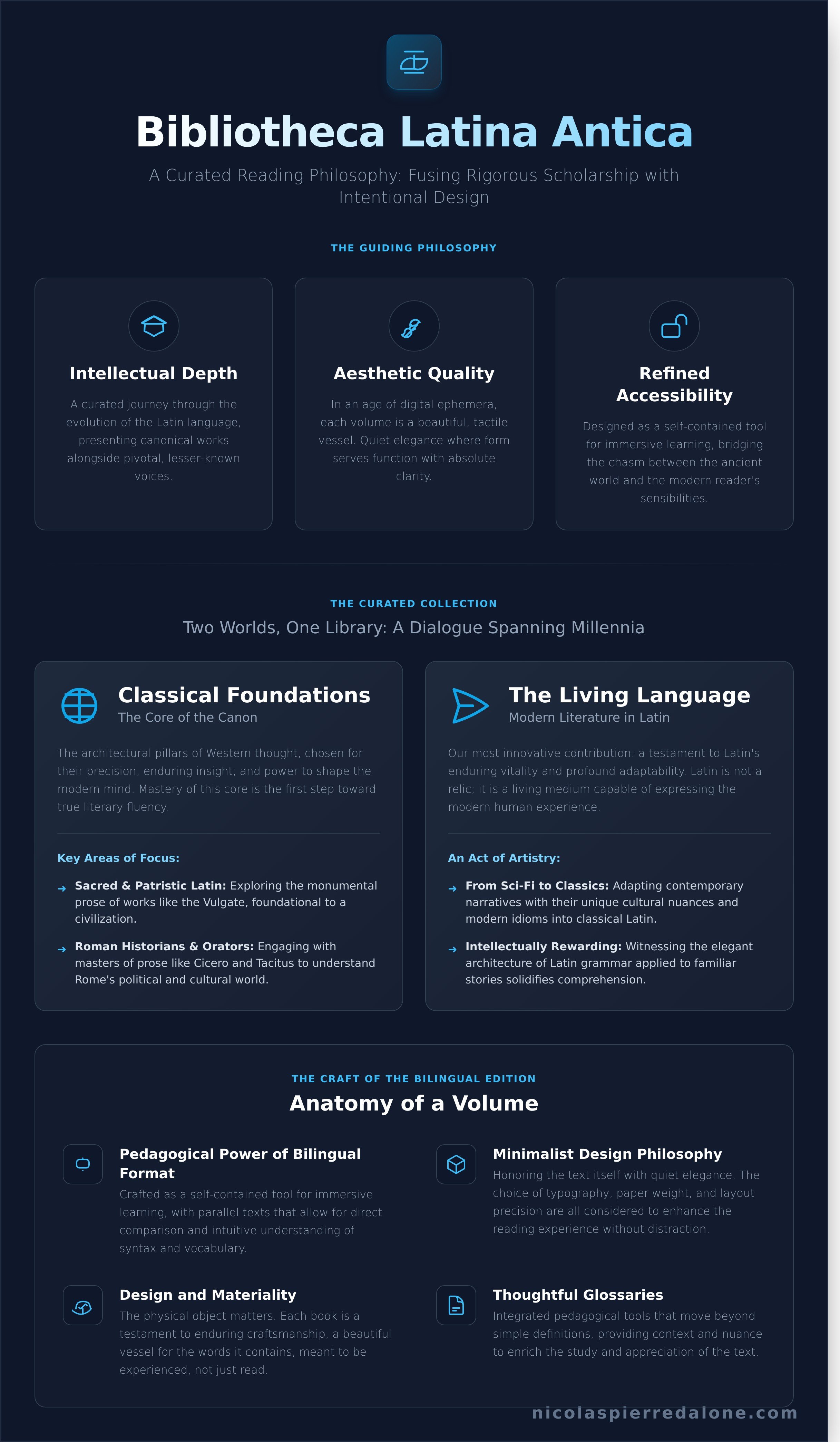
A library is more than an archive. It is a dialogue. The bibliotheca latina antica collection is conceived not as a catalogue of classical texts, but as a curated experience for the 21st-century reader. Our philosophy rests on three pillars: intellectual depth, aesthetic quality, and refined accessibility. We bridge the chasm between the ancient world and modern sensibilities, presenting Latin literature as a living, breathing heritage. Each volume is an invitation to a conversation that spans millennia.
The Art of Curation
Our selection process is an act of storytelling. We curate texts to narrate the continuous evolution of the Latin language. Canonical works by Virgil and Ovid stand beside lesser-known yet pivotal voices, creating a comprehensive narrative. This approach provides a richer context for understanding the full history of Latin literature. The editor is not a compiler, but a guide, shaping a journey that is both scholarly and deeply personal.
Design and Materiality
In an age of digital ephemera, the physical object matters. Our minimalist design philosophy honours the text itself. We believe in quiet elegance, where form serves function with absolute clarity. The choice of typography, the weight of the paper, and the precision of the layout are all considered to enhance the reading experience. The book becomes a beautiful, tactile vessel for the words it contains-a testament to enduring craftsmanship.
This collection is ultimately a statement. It asserts that classical texts deserve a presentation that matches their intellectual weight. It is a fusion of rigorous scholarship and intentional design, created for those who seek not just to read Latin, but to experience it. We offer a library where every detail, from the selection of a text to the final stitch in the binding, is part of a singular, artistic vision.
Classical Foundations: The Core of the Canon
Every significant collection begins with a curated foundation. The bibliotheca latina antica is built upon works of uncompromising intellectual and linguistic merit. These are not merely historical texts; they are the architectural pillars of Western thought, chosen for their precision, their enduring insight, and their power to shape the modern mind. Our approach is one of reverence and clarity, presenting each work as a distinct artifact of human expression.
These foundational texts provide the essential grammar of thought and style. They prepare the reader for the nuance and complexity of later literature, establishing a firm understanding of the classical world's most profound conversations. Mastery of this core canon is the first step toward true literary fluency.
Sacred and Patristic Latin
The Latin tradition was profoundly shaped by sacred texts. The Vulgate of St. Jerome, for instance, is more than a translation; it is a monumental work of Late Antique prose that defined a language for a millennium. Our editions navigate its unique vocabulary and syntax, providing the necessary context for a modern reader to appreciate its stark beauty and spiritual gravity. We reveal the linguistic texture that made these works foundational to a civilization.
The Roman Historians and Orators
To understand Rome is to engage with its masters of prose. The works of authors such as Cicero, Tacitus, and Sallust represent the pinnacle of rhetorical and historical writing. While our editions offer a curated experience, the sheer breadth of the classical corpus is available through invaluable digital archives like The Latin Library, providing unfiltered access to the original sources. Our bilingual format is engineered to illuminate the intricate syntax and persuasive power of their arguments, making the political and cultural world of the Roman elite not just accessible, but immediate.
The Living Language: Modern Literature in Classical Latin
Latin is not a relic. It is a living, breathing medium, capable of expressing the full spectrum of the modern human experience. Our most innovative contribution to the bibliotheca latina antica is the meticulous translation of contemporary works into classical Latin. This is not mere academic exercise; it is a testament to the language's enduring vitality and profound adaptability.
The process is an act of artistry. Adapting contemporary narratives, with their unique cultural nuances and modern idioms, demands more than linguistic fluency. It requires a deep understanding of both worlds-the ancient and the present. By engaging with these texts, the reader witnesses the elegant architecture of Latin grammar applied to familiar stories, solidifying comprehension in a way that is both intellectually stimulating and uniquely rewarding.
From Science Fiction to Contemporary Classics
Imagine the conceptual dissonance and intellectual delight of reading science fiction in the language of Caesar. This unique experience is at the heart of our modern collection. We curate translations ranging from the philosophical journeys of Dante to the sensory richness of works like Under the Tuscan Sun. Unlike the essential, foundational texts preserved in archives such as The Latin Library, these adaptations offer a new pedagogical pathway. Encountering a familiar story in an unfamiliar linguistic form creates powerful new neural connections and deepens appreciation for both the narrative and the language itself.
A Bridge for Learners
For the student of Latin, these modern adaptations serve as an accessible entry point to more complex, authentic texts. They are a bridge. Reading an engaging, contemporary story builds fluency and confidence, removing the initial intimidation often associated with classical authors. Each translation in the bibliotheca latina antica is also a careful expansion of the Latin lexicon, introducing neologisms for modern concepts with scholarly precision. This curated approach ensures the language grows without sacrificing its classical integrity. Explore our collection of modern Latin adaptations.
The Craft of the Bilingual Edition: A Pedagogical Vision
The design of each bibliotheca latina antica volume is an exercise in purpose. More than a simple collection of texts, it represents a considered pedagogical vision. The book itself is conceived as a self-contained instrument for learning and immersion, an artifact crafted to bridge the chasm between the ancient mind and the modern reader. Our methodology is one of deliberate restraint and focused intent.
Our translations pursue a dual mandate: absolute fidelity to the original Latin, rendered with a modern, literary elegance. This is not a simplification of the classical voice, but a careful interpretation designed to preserve its power and nuance. The result is a text that stands as a work of art in its own right, yet serves as a precise guide to the facing page.
The Parallel Text Method
The foundation of our approach is the parallel text. By presenting the original Latin alongside its English counterpart, we eliminate the friction of constant dictionary work. This format is engineered for deep reading, allowing the eye to move seamlessly between languages. Grammar and syntax are absorbed intuitively, not studied abstractly. The reader is invited into a sustained engagement with the author’s authentic voice, fostering a direct and profound connection with the text.
Integrated Glossaries and Notes
Our pedagogical aids are designed to support, not intrude. They are curated with the same minimalism and precision as the primary texts.
Glossaries: Placed discreetly at the end of each volume, these glossaries clarify essential or recurrent terms without cluttering the reading page. They are a resource, not a distraction.
Contextual Notes: Where necessary, concise notes provide essential historical or cultural context. These are crafted to illuminate the text, empowering the reader's own process of discovery rather than dictating it.
This curated ecosystem of text, translation, and annotation transforms each bibliotheca latina antica edition into a complete intellectual experience. It is an invitation to engage with the classics on your own terms. Discover the meticulous craftsmanship of the full collection at nicolaspierredalone.com.
A New Canon for the Modern Latinist
The study of Latin is no longer confined to the past. It is an evolving dialogue between heritage and the future. The bibliotheca latina antica redefines this conversation, presenting a philosophy where the foundational classics are not just preserved, but revitalized. This is a library built on the conviction that Latin remains a powerful, living language, capable of expressing everything from ancient epic to modern science fiction.
Under the banner of Plume Charmers, this vision is realized through the uncompromising craftsmanship of Nicolas Pierre d'Alone. Each volume is a curated artifact-an elegant bilingual edition designed for immersive reading. With integrated pedagogical glossaries and unique modern adaptations, these books are both tools for learning and objects of art. They represent a new standard in classical publishing, created for the discerning reader who demands both intellectual rigor and aesthetic perfection.
The collection is a testament to what is possible when tradition meets a bold artistic will. Plume Charmers invites you to experience this curated world for yourself. Discover the Bibliotheca Latina Antica collection. Your journey into the heart of a reimagined Latin legacy awaits.
Frequently Asked Questions
What is the translation philosophy behind the Bibliotheca Latina Antica editions?
Our philosophy transcends literal translation. We pursue an artistic fidelity to the original text, capturing its rhythm, intellectual weight, and nuanced spirit. Each edition is not a mere conversion of words but a curated interpretation, aiming to present the soul of the work with clarity and aesthetic integrity. The goal is to create a modern echo of the classical voice, preserving its power and elegance for a contemporary audience that values profound substance.
Are these books suitable for beginners or are they intended for advanced scholars?
These editions are conceived for the discerning reader, not the novice. They are for those who possess a foundational appreciation for classical literature and seek a deeper, more contemplative engagement. While an advanced scholar will appreciate the nuanced curation, the collection is equally suited for any dedicated connoisseur who values the intersection of literary heritage and master craftsmanship. Our volumes are designed to enrich an existing passion, not to serve as an introduction.
How do the modern adaptations help improve my understanding of classical Latin?
The modern adaptations function as a parallel artistic dialogue, not a grammatical guide. They provide a contemporary lens through which the classical text is re-examined, illuminating its timeless themes with a new aesthetic sensibility. This juxtaposition of ancient and modern deepens understanding by creating a conceptual bridge. It encourages a more profound intellectual connection to the material, moving beyond pure linguistic analysis to a richer, more holistic appreciation of the work's legacy.
Why should I choose these print editions over digital or public domain texts?
A digital file cannot replicate the sensory experience of a physical artifact. We choose print because our editions are conceived as permanent objects of art, designed to be held and cherished. The weight of the paper, the texture of the cover, and the precision of the typography are integral to the reading process. Each volume in the Bibliotheca Latina Antica collection is a testament to enduring craftsmanship, offering a tangible connection to literary heritage that ephemeral digital texts cannot provide.
What makes the design and physical quality of your books unique?
Our commitment to physical quality is absolute. Each book is a product of Italian artisanship, featuring select, uncoated papers from heritage mills and robust thread-sewn binding for heirloom durability. The typography is bespoke, and the minimalist layout is meticulously structured to create visual harmony and an uncluttered reading experience. The design is not an afterthought; it is a core component of the work itself, a silent testament to the belief that beauty elevates intellect.
Is the entire collection curated by a single editor, Nicolas Pierre d'Alone?
Yes. The entire collection is the singular vision of its founder, Nicolas Pierre d'Alone. This curatorial integrity ensures a consistent aesthetic and intellectual standard across every volume. There is no committee; each text is selected, edited, and designed under his direct authority. This approach guarantees that every publication within the Bibliotheca Latina Antica is not merely a book, but a distinct piece of a cohesive, artist-led project dedicated to classical antiquity.


Comments