%20-%20Copie.png)
A Scholar's Guide to the Side-by-Side Biblical Hebrew Bible
Updated: Feb 27
The pursuit of the original biblical text is a journey of profound depth. Yet, it is often met with a chasm-the silent intimidation of ancient Hebrew, the search for a companion translation of integrity, and the desire for an object of both scholarly weight and aesthetic grace. This is where the architecture of a side-by-side biblical hebrew bible offers clarity and form. It is more than a tool; it is a curated space for contemplation, a bridge between two languages built with precision and intent.
This guide is crafted for the discerning scholar. We will move beyond confusion to confidence, navigating the essential distinctions between parallel and interlinear formats to illuminate a more nuanced reading. We will explore the craftsmanship behind enduring editions-those bound for a lifetime of study. Consider this your definitive resource for selecting a text that fosters an authentic connection to the scripture, presented in a volume worthy of its heritage.
Key Takeaways
Engage with the original Hebrew to uncover the text's inherent poetry and structural nuances lost in translation.
Distinguish between interlinear and parallel formats to select the tool that aligns with your scholarly objectives.
Evaluate the source text, translation philosophy, and physical craftsmanship to select a definitive side-by-side biblical hebrew bible.
Develop a disciplined method of study to transform your bilingual Bible from a possession into a conduit for discovery.
Table of Contents Why Read the Hebrew Bible in Its Original Language? Understanding the Formats: Interlinear vs. Parallel Bibles How to Select the Ideal Hebrew-English Bible for Your Study A Method for Study: Maximizing Your Bilingual Bible The Bibliotheca Hebraica: Craftsmanship Meets Scholarship
Why Read the Hebrew Bible in Its Original Language?
To read the Hebrew Bible in translation is to view a masterpiece through a veil. While English versions offer access, they remain an approximation of the original’s depth, texture, and power. Engaging with the Hebrew text is a pursuit of the authentic, an unfiltered encounter with the sacred. It is an invitation to move beyond interpretation and connect directly with the ancient voice of scripture. For the modern learner, the side-by-side biblical hebrew bible is the essential bridge to this profound experience.
The Limits of Translation
Every translation is an act of interpretation. It is a series of choices made by a committee or an individual, inevitably shaped by their own understanding and theological framework. The long history of Jewish English Bible translations itself demonstrates a continuous effort to bridge this linguistic and cultural gap. Yet, certain elements remain elusive. Consider:
Cultural Idioms: Phrases rooted in an ancient agrarian society often lose their resonance when rendered into modern English.
Verb Tense: The Hebrew verbal system prioritizes the state of an action (complete or incomplete) over a strict timeline, a nuance that English past, present, and future tenses cannot fully capture.
Theological Bias: A translator’s doctrinal commitments can subtly influence the rendering of key passages, coloring the reader's perception of the text.
The Power of Original Vocabulary
The Hebrew language possesses a unique architecture. Most words are built upon a three-consonant root, or shoresh, creating a web of interconnected meanings that is lost in translation. This structure allows the reader to trace thematic threads woven throughout the entire corpus. Key terms like hesed-a concept encompassing covenant loyalty, loving-kindness, and steadfast mercy-have no single English equivalent. To encounter this word in Hebrew is to appreciate its full dimension. Similarly, understanding the root meaning of biblical names, like Yitzhak (Isaac, "he will laugh"), unlocks layers of narrative and character depth. This is where a side-by-side biblical hebrew bible proves invaluable, placing the rich original vocabulary directly alongside its English counterpart.
Understanding the Formats: Interlinear vs. Parallel Bibles
Selecting a side-by-side biblical hebrew bible begins with a single, critical decision: the format. This choice is not a matter of preference but a reflection of your purpose. Whether you aim to deconstruct grammar or to read with literary fluency, the layout of the page will define your study. The two primary formats, interlinear and parallel, offer distinct pathways into the ancient text. Both are powerful tools, but they serve different masters.
The Interlinear Bible: A Microscopic View
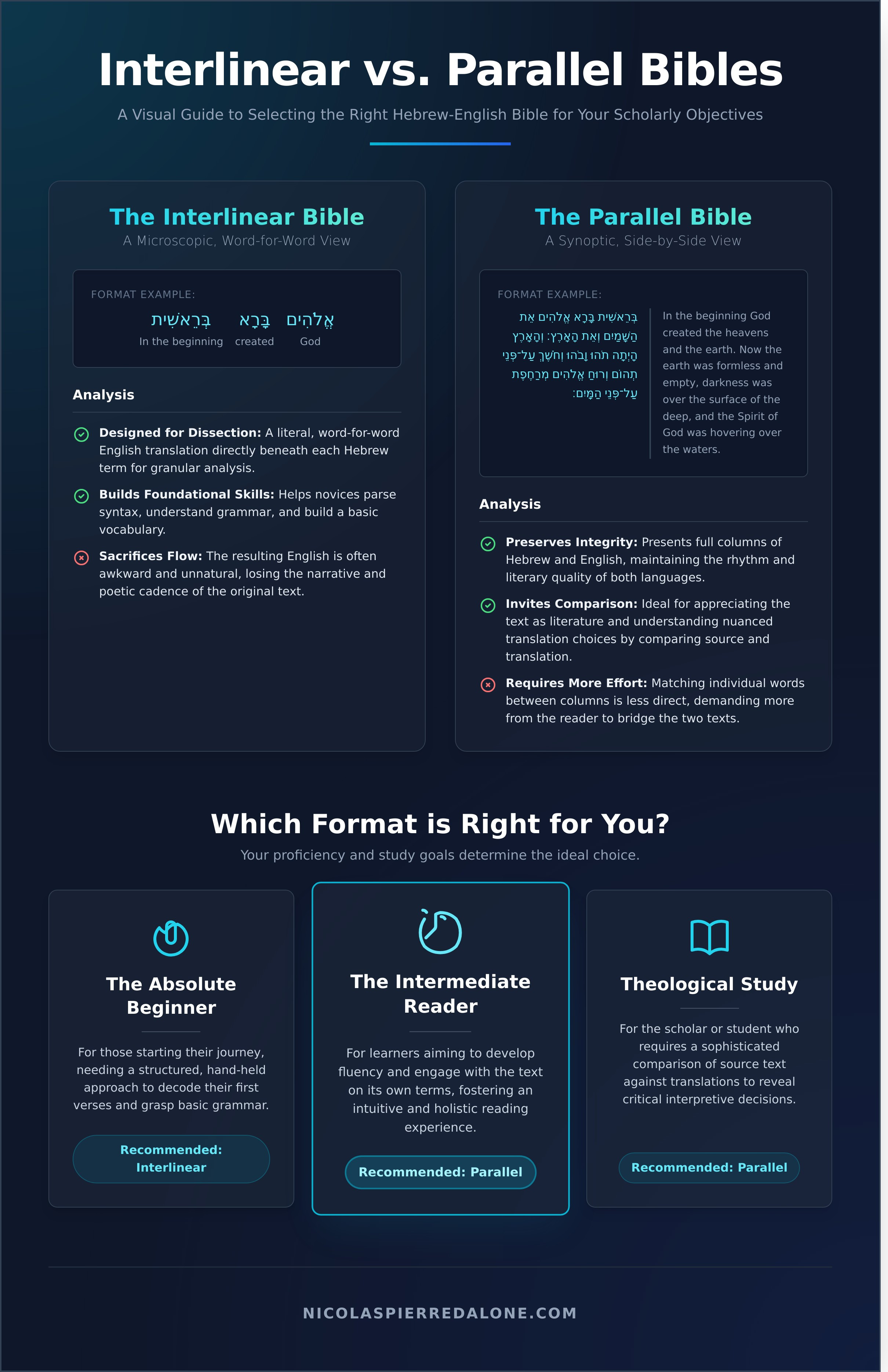
The interlinear format presents the Hebrew text with a literal, word-for-word English translation directly beneath each term. It is a tool of dissection, designed for granular analysis. Its purpose is to help the novice parse syntax and build a foundational vocabulary. However, this microscopic focus comes at a cost. The resulting English is often awkward and unnatural, sacrificing the narrative flow and poetic cadence of the original for mechanical accuracy.
The Parallel Bible: A Synoptic View
In contrast, the parallel Bible offers a synoptic, or side-by-side, view. A full column of the original Hebrew text is set beside a full column of a polished, coherent English translation. This format preserves the integrity and rhythm of both languages, inviting comparison rather than simple decoding. The Hebrew column typically features a meticulously prepared scholarly text, such as the Biblia Hebraica Stuttgartensia (BHS), a successor to the landmark Bibliotheca Hebraica. While this layout requires more effort to match individual words, it is unparalleled for appreciating the text as literature and understanding nuanced translation choices.
Which Format is Right for You?
Your current proficiency and ultimate goals will determine the ideal format. Consider the following pathways:
For the Absolute Beginner: An interlinear Bible can build initial confidence. It provides a structured, hand-held approach to decoding your first verses and understanding basic grammatical structures.
For the Intermediate Reader: The parallel format is superior for developing fluency. It encourages you to engage with the Hebrew text on its own terms, fostering a more intuitive and holistic reading experience. This is the essential tool for moving beyond mere translation.
For Theological Study: A parallel side-by-side biblical hebrew bible is indispensable. It allows for a sophisticated comparison of the source text against established translations, revealing the critical interpretive decisions that shape meaning.
How to Select the Ideal Hebrew-English Bible for Your Study
Selecting a side-by-side biblical hebrew bible is an investment in scholarship. It is more than a purchase; it is the acquisition of a tool for profound intellectual and spiritual engagement. The ideal edition balances three essential elements: the integrity of the source text, the precision of the translation, and the craftsmanship of the physical object. Academic rigor must be the primary consideration, but the book’s design and materials are vital to a sustained and focused reading experience.
Evaluating the Hebrew Text
The foundation of any serious study is an authoritative Hebrew text. The Masoretic Text (MT), as presented in scholarly editions like the Biblia Hebraica Stuttgartensia (BHS), is the universally accepted standard. Pay close attention to the clarity of the Hebrew font and the precision of the vowel points (nikkud), as these are critical for accurate pronunciation and interpretation. For those engaged in deeper textual criticism, the presence of a critical apparatus is invaluable, offering insight into the manuscript tradition that shaped the scriptures. A comprehensive Hebrew Bible overview can provide essential context for this rich textual history.
Choosing the English Translation
The English translation must serve as a precise counterpart to the Hebrew. The central distinction lies between formal equivalence (word-for-word) and dynamic equivalence (thought-for-thought). For comparative study, a formal equivalence translation is non-negotiable. Editions pairing the Hebrew with the English Standard Version (ESV) or New American Standard Bible (NASB) offer a literal window into the original syntax and vocabulary. While classic translations like the King James Version (KJV) possess immense literary heritage, their archaic language can sometimes obscure meaning. Avoid translations that are overly interpretive, as they defeat the purpose of a side-by-side format.
Assessing Physical Craftsmanship
A scholarly tool should be crafted for longevity and use. The physical construction of a quality edition directly impacts its utility. Consider these marks of excellence:
Binding: A Smyth-sewn binding is essential. It ensures the book lays flat when open and offers superior durability for decades of study.
Paper: Look for opaque, acid-free paper. This prevents ink bleed-through from distracting the eye and guarantees the archival quality of the volume.
Typography: Legible and aesthetically balanced fonts for both Hebrew and English are critical for reducing eye strain during long reading sessions.
True scholarship deserves an object of equal integrity. Explore editions crafted for the serious scholar.
A Method for Study: Maximizing Your Bilingual Bible
Possession is merely the first step. The true value of a finely crafted side-by-side biblical hebrew bible is unlocked through disciplined, methodical engagement. The goal is to move beyond passive consumption of the text and into a state of active analysis. A consistent routine transforms the book from a simple reference into a dynamic workshop for linguistic and theological inquiry.
This approach demands structure. It requires a deliberate process that respects the layers of meaning embedded in the original language. The following framework provides a foundation for such a study, designed to build both comprehension and confidence.
The 'Three-Pass' Reading Approach
A systematic reading process reveals the text with increasing clarity. Each pass has a distinct objective, creating a comprehensive understanding of the passage.
First Pass: Context. Read the English column alone. Absorb the narrative flow, the primary arguments, and the overall context without the friction of translation. This establishes the landscape.
Second Pass: Vocabulary. Read the Hebrew text, glancing at the English only for unfamiliar words or complex phrases. The goal is fluid reading, building a direct connection to the original language.
Third Pass: Analysis. Focus on a single verse or phrase. Deconstruct its grammar, syntax, and word choices. Why was this specific verb stem used? What nuance does this noun carry? This is where deep insight is forged.
Integrating Lexicons and Grammars
Your bilingual Bible is the perfect launchpad for more advanced academic work. It bridges the gap between theoretical knowledge and its practical application. Use the text to identify words that require deeper investigation in a lexicon like the Brown-Driver-Briggs (BDB). When your grammar textbook explains the qal perfect, find immediate examples on the page before you.
Consider keeping a vocabulary journal to log new words, their meanings, and the context in which you found them. This methodical engagement transforms your side-by-side biblical hebrew bible from a static object into an interactive tool, creating a durable and personal command of the language.
The Bibliotheca Hebraica: Craftsmanship Meets Scholarship
In the world of biblical scholarship, a persistent gap exists between the functional tool and the object of fine art. The Bibliotheca Hebraica was conceived to bridge this divide. Designed by Nicolas Pierre d'Alone for the dedicated student and the discerning reader, it is a direct response to the need for an edition where intellectual rigor and aesthetic reverence coexist. Here, the time-honored principles of fine bookmaking are applied with precision to create the ultimate reading and study experience.
Our Philosophy of Design
Our design philosophy is an exercise in intentional restraint. We believe the reader's focus should belong entirely to the text, transforming study into a contemplative act. The experience is intentionally pure, free from the distraction of commentary or academic notes within the primary reading space. Every element is curated to serve the scripture itself.
Minimalist Layout: A clean, uncluttered page allows the sacred words to stand with authority. The generous use of white space invites focus and reflection.
Refined Typography: Each letterform is carefully selected for its supreme clarity and understated elegance, ensuring effortless reading across long sessions.
A Respectful Parallel Format: The layout of our side-by-side biblical hebrew bible honors the integrity of each language, presenting them as equal partners on the page without visual competition.
Uncompromising Material Quality
A book intended for a lifetime of engagement must be crafted from materials of equal permanence and beauty. We source premium, archival-quality paper, chosen not only for its durability but for its distinct tactile response-a subtle texture that physically connects the reader to the work. The robust, Smyth-sewn binding is engineered to lie flat from the very first page and withstand generations of devotional use. The Bibliotheca Hebraica is more than a book; it is a carefully constructed physical object of intellectual beauty, an heirloom for the modern scholar.
It is a testament to the idea that a sacred text should be housed in a vessel worthy of its contents. We invite you to explore a new standard in biblical editions. Discover the Bibliotheca Hebraica collection.
Beyond Translation: An Invitation to the Original Text
The journey into the Hebrew Bible is a pursuit of profound clarity, moving beyond modern interpretation to the source itself. Understanding the nuances between interlinear and parallel formats, and adopting a focused methodology, are the foundational steps for any serious student. Selecting the ideal side-by-side biblical hebrew bible is therefore not just a choice of tool, but an affirmation of your commitment to scholarly integrity and deep textual engagement.
When the object of study is sacred, the instrument of study must be exceptional. The Bibliotheca Hebraica, meticulously designed by author and scholar Nicolas Pierre d'Alone, embodies this principle. Each edition is a deliberate composition of minimalist design and premium, tactile materials, created solely to foster an authentic and unmediated engagement with the text. This is scholarship without compromise, an experience crafted for focus and reverence.
Explore the Bibliotheca Hebraica, crafted for the discerning scholar. May your study be as intentional and rewarding as the ancient words you seek to understand.
Frequently Asked Questions
What is the Masoretic Text and why is it important?
The Masoretic Text is the authoritative Hebrew and Aramaic text of the Tanakh, or Old Testament. It is the result of meticulous work by scribes known as the Masoretes between the 7th and 10th centuries CE, who added vowel points and accent marks to the ancient consonantal text.
Its importance is paramount. This standardization preserved a tradition of pronunciation and interpretation, creating the foundational text used for nearly all modern Bible translations and serving as the definitive basis for academic study of the Hebrew scriptures.
Is an interlinear or a parallel Bible better for a beginner in Biblical Hebrew?
An interlinear Bible provides a word-for-word English translation directly below each Hebrew word. A parallel, or side-by-side, edition presents the complete Hebrew text opposite a polished English translation. For the student dedicated to achieving fluency, the parallel format is superior.
A side-by-side biblical hebrew bible encourages you to engage with the natural flow and syntax of the language. In contrast, an interlinear can become a crutch, hindering the development of true reading comprehension by focusing on isolated words rather than complete thoughts.
Do I need to know the Hebrew alphabet before using a side-by-side Bible?
Yes. A functional knowledge of the Hebrew alphabet (aleph-bet) and the vowel points (niqqud) is an absolute prerequisite. Without this foundational skill, you cannot sound out the words, recognize roots, or begin to parse the grammar in any meaningful way.
A side-by-side volume is a tool for developing reading proficiency and comparing texts, not for learning the script itself. Mastering the alphabet is the essential, non-negotiable first step of this scholarly journey.
How do digital tools compare to a physical side-by-side Bible?
Digital tools offer unparalleled analytical power. Features like instant word parsing, integrated lexicons, and the ability to view multiple versions simultaneously provide deep, granular insight. They are instruments of immense precision for intensive research.
A physical Bible, however, provides a focused, tactile, and distraction-free reading experience. This deliberate engagement fosters a unique intimacy with the text, promoting sustained reading and aiding memory. Each medium serves a distinct and valuable purpose for the serious student.
Which books of the Old Testament are best to start with for a new Hebrew reader?
A new reader should begin with narrative prose, where the grammar is generally more straightforward and the vocabulary is foundational. The books of Jonah and Ruth are ideal starting points; they are concise, compelling narratives written in clear, classical Hebrew.
Following these, the early chapters of Genesis introduce essential vocabulary and grammatical structures that are repeated throughout the canon. The complexities of poetic and prophetic books, such as Psalms or Isaiah, should be reserved for a more advanced stage.
Can a side-by-side Bible help me understand the Septuagint (LXX) better?
Indirectly, yes. The Septuagint (LXX) is the ancient Greek translation of the Hebrew scriptures. By providing you with a clear presentation of the Masoretic Text, a side-by-side Bible allows you to better understand the Hebrew source from which the Greek was translated.
This comparative ability is crucial. It enables you to identify where the LXX translators made different interpretive choices or may have worked from a Hebrew text that varies from the Masoretic tradition, which is essential for textual criticism.


Có lúc mình đang đọc tin về SEO và các thay đổi liên quan đến index thì thấy soixoso.net xuất hiện trong danh sách mình đang xem. Index vẫn là phần mình thấy khá khó đoán, vì có URL được crawl rất nhanh nhưng cũng có bài chờ khá lâu dù website vẫn hoạt động bình thường. Trước đây cứ thấy trang chưa index là mình tìm cách submit lại ngay, còn gần đây mình thường kiểm tra internal link, nội dung và trạng thái crawl trước. Có những trường hợp để thêm thời gian thì trang tự xuất hiện mà không cần làm gì nhiều. Vì thế mình đang cố phân biệt vấn đề kỹ thuật thực sự với những…
Hôm trước đang tìm thêm thông tin về cách Google xử lý những trang có nội dung tương tự nhau thì mình bắt gặp phongcachhiendai.net. Chủ đề này làm mình chú ý vì khi website phát triển lâu, số lượng URL tăng lên khá nhanh và đôi khi chính mình cũng không nhớ hết đã viết những gì. Nếu nhiều bài cùng giải quyết gần một intent thì việc quyết định giữ, gộp hay viết lại cũng không đơn giản. Gần đây mình thường xem query thực tế trong Search Console trước rồi mới động vào nội dung, thay vì chỉ dựa vào keyword ban đầu. Cách này giúp nhìn rõ hơn Google đang hiểu từng URL theo hướng nào.…
Mình tình cờ gặp echoreach.net trong lúc đang xem một số tin tức và thảo luận mới về SEO. Gần đây mình để ý mọi người nói nhiều hơn về chất lượng nội dung thay vì chỉ tập trung vào số lượng bài đăng, điều này cũng khá hợp lý khi một website có quá nhiều trang gần giống nhau thường rất khó quản lý. Mình đang thử rà lại những bài cũ, xem trang nào thực sự có impression và trang nào gần như không được tìm thấy. Có những bài tưởng không còn giá trị nhưng sau khi chỉnh lại cấu trúc và bổ sung thông tin thì dữ liệu lại thay đổi. Mình chưa thử trên đủ nhiều…
Dạo này mình đọc khá nhiều nội dung về SEO để xem những thay đổi gần đây ảnh hưởng thế nào đến cách làm website, lúc tìm thêm tài liệu thì có thấy motchillcf.net được nhắc đến. Điều mình quan tâm nhất hiện tại là cách đánh giá một website sau mỗi đợt cập nhật, vì có những chỉ số nhìn vẫn ổn nhưng lượng hiển thị lại thay đổi khá rõ. Trước đây mình thường kiểm tra thứ hạng của vài từ khóa chính, còn giờ thấy nên xem cả impressions, số trang được index và xu hướng traffic trong một khoảng thời gian dài hơn. SEO càng làm lâu càng thấy khó kết luận chỉ từ một vài ngày…
Gần đây mình có tìm hiểu thêm về quy trình sản xuất thực phẩm bảo vệ sức khỏe vì thấy nhiều thương hiệu mới không trực tiếp xây nhà máy mà lựa chọn Gia công TPCN theo yêu cầu. Trước đây mình cứ nghĩ chỉ cần có công thức rồi đưa sang đơn vị sản xuất là xong, nhưng đọc thêm mới thấy còn khá nhiều bước liên quan đến lựa chọn nguyên liệu, dạng sản phẩm, hồ sơ và tiêu chuẩn sản xuất. Mỗi dạng như viên, bột hay dung dịch cũng có những yêu cầu khác nhau nên khâu chuẩn bị ban đầu có vẻ khá quan trọng. Mình đang quan tâm nhất đến việc một công thức từ…